
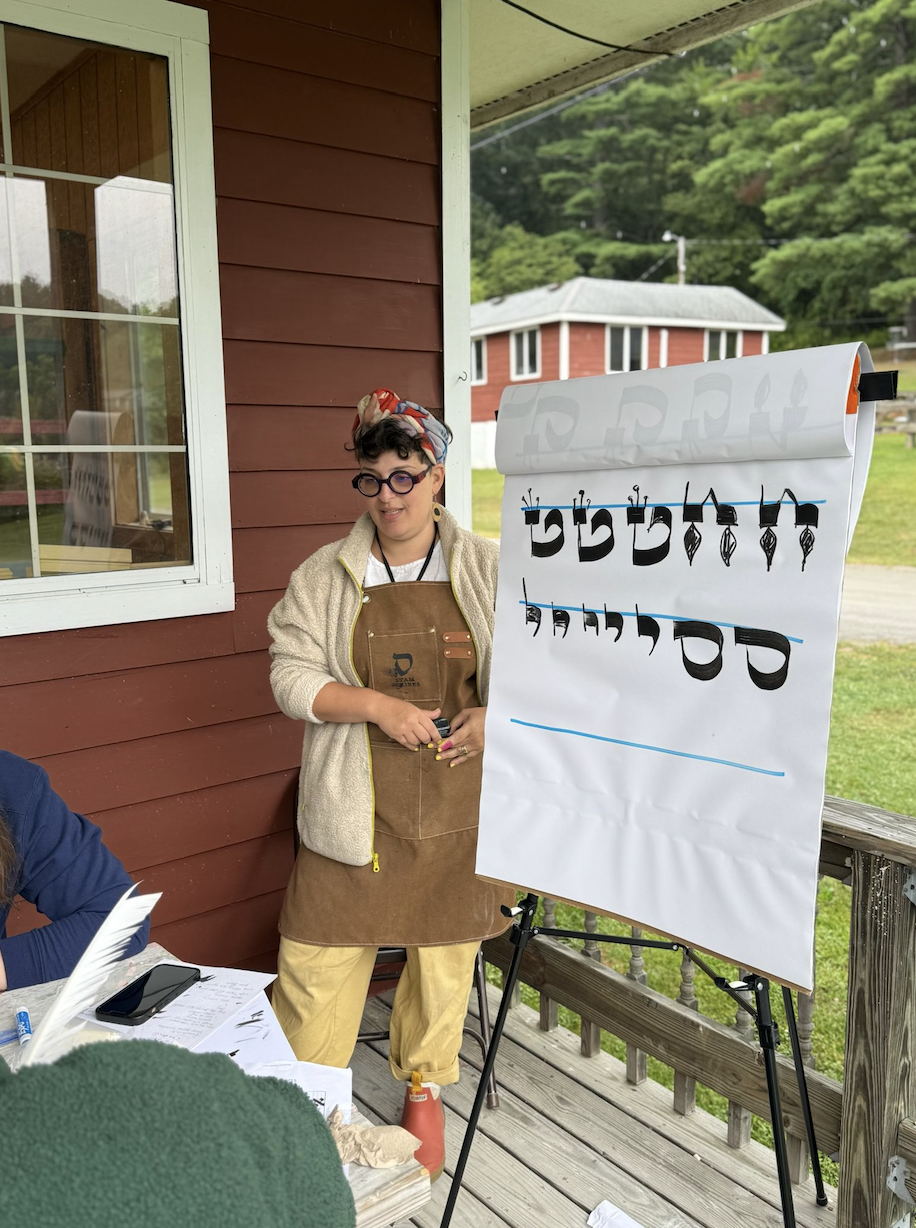
I came to scribal arts almost by accident.
I was studying torah at Pardes Institute in Jerusalem and signed up for an introductory class with Rabbi Dov Laimon, partly out of curiosity, partly because I’ve always been a hands-on, tactile learner. The idea of a craft that was also holy pulled me in.
I still remember my first class. I sat down with a piece of practice klaf that someone else had already written on, and as I ran my fingers over the surface, I could feel the ink raised against the parchment.
And I had this sudden, disorienting realization: sifrei torah, along with so many of the ritual objects we use, are not abstract or mystical in the way I had imagined them. They are physical things. Made by real people. With real tools. Through careful, skilled, human work. That moment shifted something for me. It broke down a barrier I didn’t even realize I had been holding, that these objects somehow existed outside of human touch. Instead, I began to understand them as the result of a holy craft.
What started as a class turned into a long path of study, practice, and eventually professional work. I didn’t set out to become a soferet, I’m trained as an American Sign Language interpreter, but over time I found myself taking on more projects, teaching, and creating spaces for others to encounter this work firsthand.
When I’m working on a sefer torah, it rarely feels dramatic or mystical. Most of the time, I’m focused, methodical, trying not to fall into the rabbit hole of fixing every tiny imperfection, and instead keeping the work moving with care and intention. But there is something I return to again and again.
Repairing a sefer torah is, in a real sense, a collaboration across generations. I am stepping into work that began long before me, filling in letters written by another hand, gently removing damage, reinforcing what has weakened over time. It often feels like I am professionally holding hands with sofrim I will never meet, helping sustain their work so that a community can continue reading from it for decades to come.
A central part of my work is opening up scribal arts to others. I love working in classrooms, camps, and community spaces where people can engage directly with the materials, experimenting with ink, parchment, and tools, and discovering that this tradition is something they can touch. Some of my favorite moments have been the most unstructured ones: a room where people wander in and end up staying, where a repair project turns into a shared effort, kids sanding patches in one corner, adults sewing seams, community members working together to reinforce their own megillah.
I keep a running list of questions people ask me, because even though some come up again and again, I am constantly surprised by the curiosity people bring to this work. That curiosity, and the chance to meet it, is one of the most meaningful parts of what I do.
Alongside my work with sifrei torah, I also create and write ketubot. A ketuba is one of the central rituals of a Jewish wedding, and for many couples, it becomes the most formal and enduring way they articulate the values they hope will shape the life they’re building together. I love supporting couples in that process, whether they come with a text already in hand or are looking for guidance in how to approach crafting something that feels true to them.
What I find most meaningful is witnessing the partnership itself, the shared decision-making, the care and thought couples bring as they shape language together. There’s something deeply moving about being invited into that process at such a pivotal moment. Some of my favorite work has been with couples who weren’t sure, at one point, that a ketuba reflecting their relationship would be possible. Being part of creating something that feels both rooted and expansive, something they can stand behind fully, is a privilege I don’t take lightly.
I live in Manhattan with my wife, two sons, and our dog, and my work is shaped by an egalitarian halachic perspective that sees sacred scribal practice as something people across identities can access and participate in. My work spans writing, repair, teaching, and community engagement, with a particular focus on making scribal arts more visible, approachable, and hands-on. Whether I’m working on a sefer torah, teaching a group encountering these materials for the first time, or creating opportunities for people to participate directly in the process, my goal is the same: to help bridge the gap between sacred objects and the people they belong to.
Because this work is deeply rooted in values and tradition, I believe it’s important for communities to work with a sofer or soferet whose approach aligns with their own. I aim to bring both technical care and thoughtful intention to each project, while also opening the door wider for people to connect with this work in meaningful, tangible ways.
What I do
Skills Class
Sofer Torah Check & Repair
Ketubot
Tefillin Inspection & Repair
Various other safrus projects included but not limited to: semicha klafim, b-mitzvah certificates, and excerpts of liturgical texts
Artwork